Choose Your Own Adventure
By Anna Beresin
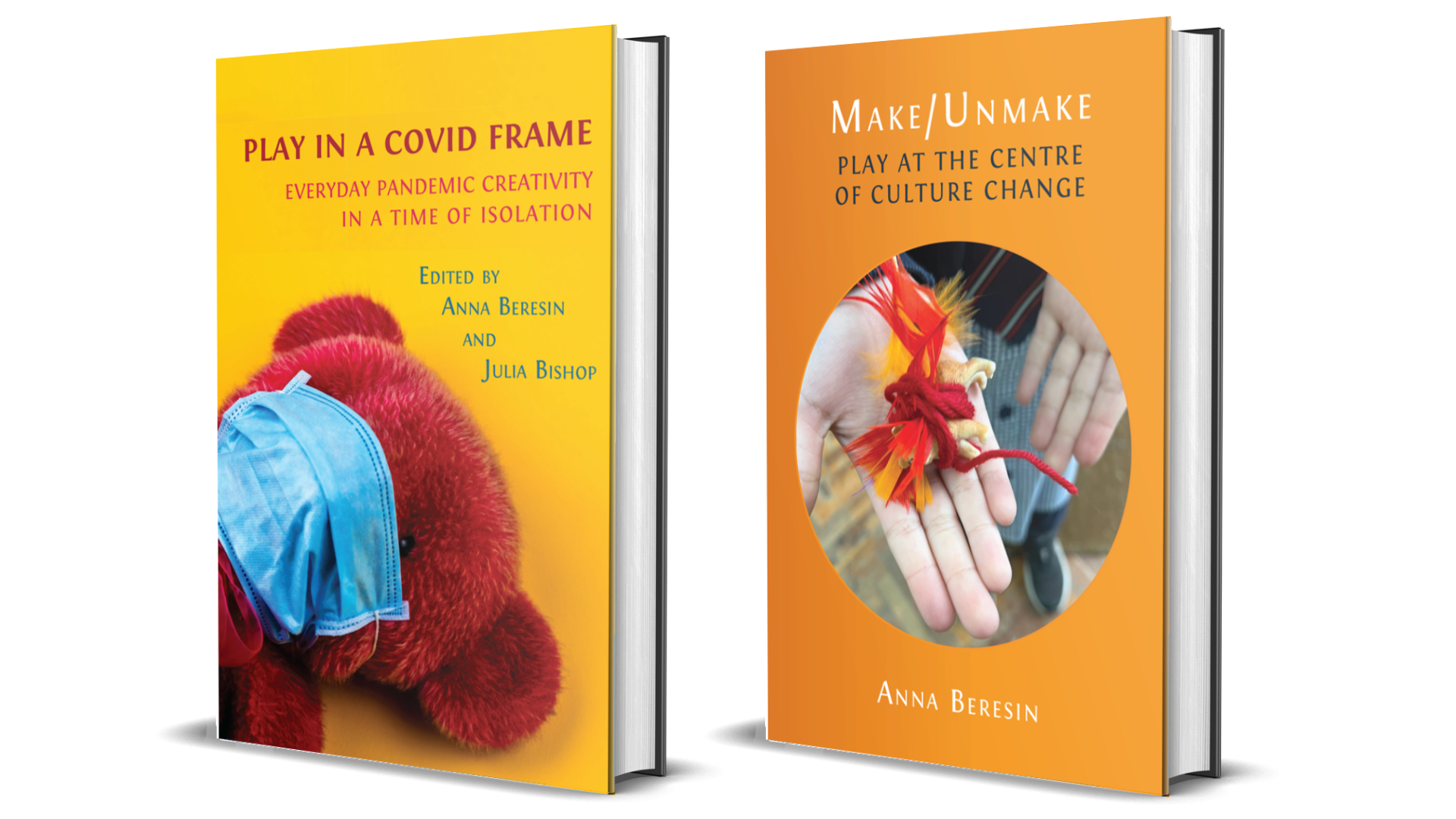
As an ethnographer, psychologist, and folklorist, I have spent forty years studying children’s play and childlore, often the only adult outsider on a children’s playground, paper or sound recorder in hand. The field of play and culture studies places the objects and motifs of childhood within their own contexts, balancing at the intersection of the social sciences and the humanities. I have written about play after the Rodney King Case, and after 9/11 in the United States, and with Julia Bishop edited a global volume about play during the Covid-19 pandemic. These books include songs sung, games crafted, and objects and drawings made. Thanks to this gracious publisher, Play in a Covid Frame is available for purchase and free download.
My new book Make/Unmake: Play at the Centre of Culture Change examines what UNICEF calls the three greatest challenges currently facing children globally, now and into the future: migration, the climate crisis, and changing forms of work. Make/Unmakeoffers what I hope to be two different poetic paths of engaging with the material presented as three different communities wrestled with immigration, recycled materials, and their own future work ambivalence. The physical book and free download offer images, original photographs of children’s sculptural play with those children’s identities masked. There is also an audio book, but that has no images, yet it reflects the rhythm of the poetic narration offered by the adults who cared for these children and for their creations. Both the written book and the audiobook honor the verbatim words of named adults in the communities studied: The Pitsmoor Adventure Playground and the Maker{Futures} Mobile Makerspace of Sheffield, England, and the GLUE Collective of nearby Birmingham. As is traditional in ethnographic practice, the author gives equal weight to the words of living participants in these communities as it does to respected scholars in the field of play. Both the audiobook and the physical book can be found here (the audiobook is available as a free MP3 download).
Why mask the children’s identities, but not the adults’ identities in this book, you might ask? These three programs serve children in vulnerable communities, and masking children’s identities keeps them safe. All of the children in the study gave verbal and written permission to be photographed and filmed, as did their parents, and each child’s face was covered in a variety of methods ranging from blurring the children’s faces to just photographing the children’s hands. In order to honor the poetry of children’s physicality connected to their object play, I experimented with placing images of children’s homemade objects on their faces as digital masks- both in the still photography and in the short research film made. The adults agreed that the methods sufficiently protected the children, and this assured the research review boards that the priority of protection came first. The adults in the three communities studied rightly wished to get credit for their hard work, for their roles as leaders in their communities and so, they are proudly named. Each program has read drafts of the book before publication, satisfied with their work and mine, a multi-layered process of editing, revoicing, and reclaiming. I imagine further discussions emerging about the social sciences’ desire to protect people’s identities as the humanities holler to give people credit where credit is due for their creations.
I was influenced by the field of ethnopoetics in folklore and conversation analysis, and also by the work in sociolinguistics about the poetry of everyday speech. One of my practices is to repeat powerful excerpts from the chapters as a form of book summary, and to link them by theme at the book’s end, a natural found poem, a printed form of spontaneous spoken word as spoken by the people studied. Listen for the rhythm, the rhyme, the subtle repetition in this excerpt from the conclusion:
That much freedom? Really? Really?
Sometimes parents say, ‘Where’s the activity?’
I just point to the all the materials.
Don’t they see?
‘Well, they’re just playing’.
But you’ve not watched.
You may have observed,
But you’ve just not seen what other people are seeing. . .
The words are poetry. The objects are poetry. Will you be led by your ears or by your eyes?