The cost of open access books: six years on
http://doi.org/10.11647/OBP.0173.0301

In 2020, we had published over 170 titles, at a rate of between 24–30 books per year. Now we are approaching our 500th publication and we publish between 55–70 books per year: a more than 100% increase. Here we reflect on how this has been achieved.


In May 2020, we published a thorough discussion of how much it costs us to publish an open access (OA) book, using the figures from our October 2018–September 2019 financial year. We included information about our costs; the revenue streams that enable us to meet those costs; and how we saw this approach ‘scaling’ in the near-to-medium-term future. We did this “to provide some of the numbers that are currently missing and to counter some of the prevailing assumptions about funding OA books.” Since this year’s Open Access Week theme is ‘The cost of knowledge’, now seems a good time to revisit this piece from almost six and a half years ago and to reflect on what is different today: the changing context we’re working in, how our own costs and revenue models have shifted, and what the future looks like now.
Output
We are a scholar-led, non-profit, Diamond OA book publisher (that is to say, we don’t charge readers to access our books and we don’t charge authors a compulsory fee to publish with us). All of our books are freely available under a Creative Commons licence from the date of publication, in PDF and (usually) HTML; we also sell copies in paperback, hardback, and (usually) EPUB formats. In our 2020 post we talked in more detail about our approach to publishing and the quality of our work; we won’t repeat this here but encourage you to read the relevant sections of that post (which are almost entirely[1] still accurate) if you would like to know more.
In 2020, we had published over 170 titles, at a rate (at the time of writing) of between 24–30 books per year. Now we are approaching our 500th publication and we publish between 55–70 books per year: a more than 100% increase in our annual publication rate. It’s worth reflecting on how this increase has been achieved.
Costs
As we pointed out in our 2020 post, conversations about OA books often jump straight to revenue, with the Book Processing Charge (BPC) the most common model used. BPCs don’t necessarily reflect cost, however; they are what the publisher charges to publish a book OA, which might not be what it costs them to do so. And if costs can be kept lower, revenue can go further.
We are a non-profit publisher, so we also do not need to make additional revenue for shareholders. Our operations are entirely structured around our key objective: making high-quality research as widely accessible as possible. Financial sustainability is obviously important, but any surplus is reinvested so we can publish more titles. Our full financial statements are publicly available online at Companies House.
As was the case in 2018–2019, we have two operational ‘arms’ of OBP: a publishing arm (the core of our work, publishing OA books) and a software development arm (developing open source software to support OA book workflows and infrastructure). The latter arm has been funded entirely from research and development grants received for that purpose. So here we separate out the costs and revenue of our publishing operation only—although, as we will go on to discuss, the infrastructure built over the last six and a half years by these R&D projects has significantly increased our efficiency and enabled us to improve the quality of our books in important areas such as accessibility.
If we look at our most recent complete financial year Oct 2025–Sept 2026, we see the following costs (NB: these figures are for our most complete financial year, which has only just ended, and so they are provisional at the time of writing):
During this period, we published 57 new books (compared to 25 in 2018–2019), which is an obvious explanation for the overall increase in costs.
However, in our 2020 post, we also shared the average ‘first copy’ cost of production for our titles. This can be obtained by considering ‘Total costs’ less ‘Printing costs & royalties’ (which are associated entirely with costs incurred after the first copy) and dividing by total number of titles published.
Average ‘first copy’ cost of production = £6,594 per title (compared to £5,266 in 2018–2019)
The overall first-copy costs have risen by just over £1,000 per title in six and a half years. Within that, however, there are some more complex shifts.
Changes since 2018–2019
In 2020, we noted that our offices in King’s College, Cambridge were rented to us at favourable terms. Since the conclusion of the pandemic, we moved to fully remote working, so we now have no rental costs at all included in ‘Overhead’. However, there has been a significant increase in our IT costs (from £1,400 to £9,750) reflecting both our increased publishing output and the increased cost of these services over time. We also now make contributions to the Open Book Collective’s Development Fund (£3,200) which awards grants ‘to build capacity to increase the quantity, quality and diversity of Open Access books’ (this is part of the ‘scaling small’ ethos we will discuss below).
There has also been a significant increase in our title production costs; this is because we now outsource some specialist typesetting work to a trusted freelance colleague, and because of external copyediting for a specific series that requires a substantial degree of subject-specific knowledge.
Inflation has obviously been a factor, with significant changes to the inflation rate during this period. Overall, the Bank of England’s inflation calculator estimates that goods and services costing £5,266 in 2020 (our first-copy costs back then) would be expected to cost £6,957 in August 2026—so our first-copy costs increase overall is about 5% below inflation.
Comparisons
As we noted in our previous post, and as we still think relevant today if comparing OBP with many other presses,[2] our acquisition costs are likely significantly lower. This is because we do not invest money in e.g. travelling to conferences to meet and persuade potential authors, or take on other significant costs that might support a competitive acquisitions process. We receive many high-quality proposals, and we are not interested in approaching acquisitions as an area in which to compete with other presses for advantage. Instead we pursue a collaborative ‘scaling small’ approach that we will discuss in more detail later in this post.
Our distribution costs, which in any case are not typically part of ‘first-copy’ cost calculations but are nonetheless costs that a press has to cover, are also likely lower than those of many other presses because most distributors, of both printed editions and ebooks, take a margin of 30-60% of the sale price of the title. Given that our printed titles typically retail at less than £30–£50, and ‘legacy’ publications typically retail at prices in excess of £60–£120, it seems likely that distribution costs associated with our printed titles are, at most, half of those for legacy publishers. Distribution costs for digital editions are considerably less, since the vast majority of people access our digital titles at no cost (the hosting costs we incur for this are incorporated into our ‘Overheads’ cost). We also now have the benefit of Thoth Open Metadata to support our distribution, which has considerably lessened the staff time required, as we will go on to discuss.
Revenue
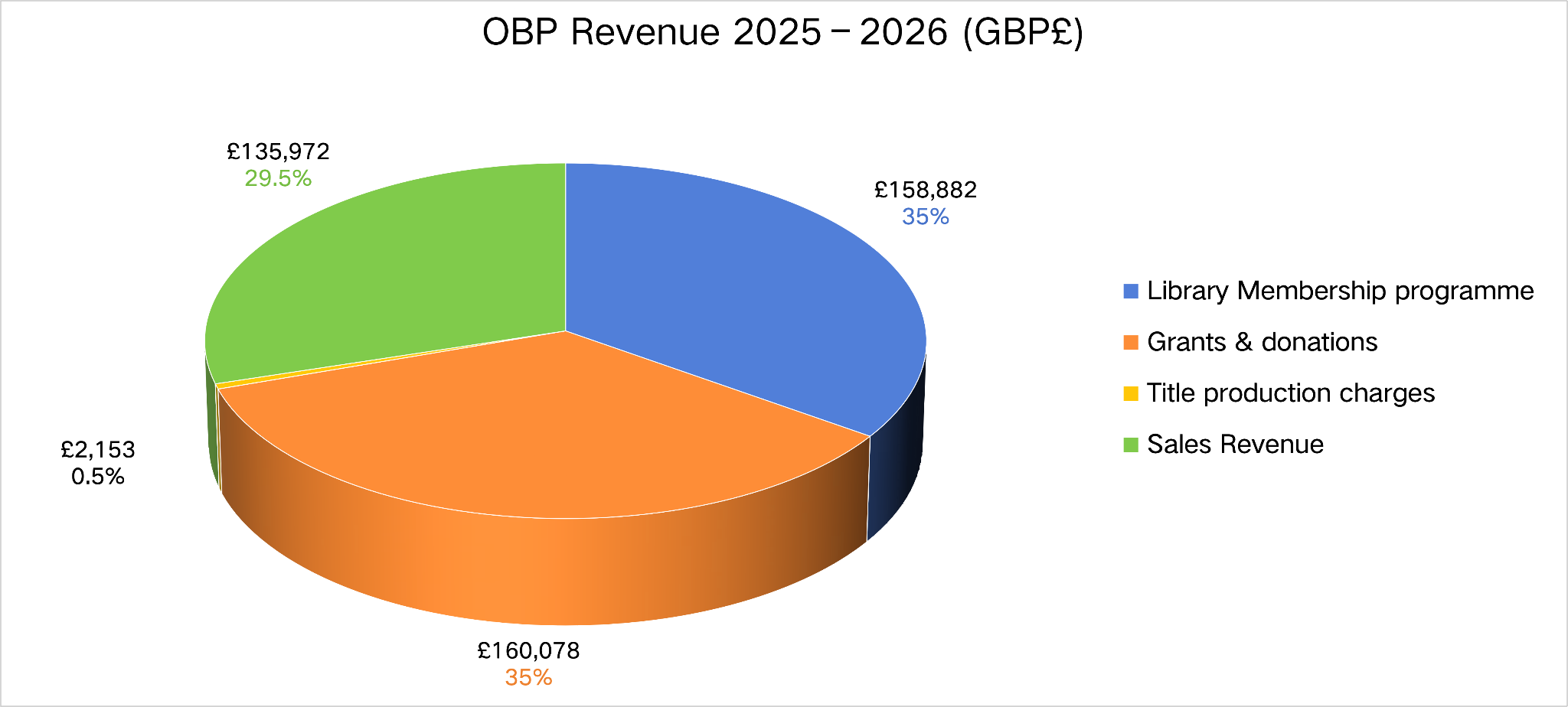
As with our costs, if we look at our most recent complete financial year Oct 2025–Sept 2026, we see the following revenue figures (NB: these figures are for our most complete financial year, which has only just ended, and so they are provisional at the time of writing):
As was the case in 2018–2019, we have three main revenue streams: sales, income from our Library Membership Programme, and grants and donations.
Changes since 2018–2019
The amount of revenue we are bringing in has significantly increased relative to 2018–2019, for two main reasons:
- We are now publishing many more books, which results both in increased sales revenue overall (although per title our sales revenue has decreased, which we will be blogging about in the near-ish future)[3] and in increased grant income, since grants are mostly tied to particular books. In 2025–2026, out of 57 books published, 13 had all of their costs funded by grants and 15 had partial grant funding attached. This means we published 29 books without any grant funding whatsoever. In total, 34 books could only be published thanks to either complete or partial support from a combination of our Library Membership Programme and our sales revenue.
- Our Library Membership revenue has increased, both because we have more Library Members (around 100 more compared to 2019) and because we have adjusted our membership fees, from a flat rate of £300 a year per library in 2019, to a tiered annual system in 2026. (We are also now members of the Open Book Collective (OBC), which didn’t exist in 2019, and we will discuss the impact of this more fully below.) Most of our libraries belong to a tier between £300–£700 depending on their size, while a small number have elected to join our ‘Quarto’ tier at £1,500 per year or our ‘Folio’ tier at £5,000 per year. Our Library Membership programme was effectively our joint-largest income stream in 2025–2026 at 35% and £158,882, increased from £42,137 in 2018–2019, when it was the smallest strand and represented only 23% of our income. (Our revenue from grants and donations was only 0.25% and £1,196 higher than our Library Membership income at £160,078; this includes individual donations as well as title grants.) It is important to emphasise that this substantial income from our Library Membership Programme (which one could argue, given our average first-copy costs, funds 24 OA books by itself), comes at a cost to each individual library of a fraction of the average BPC for one book—a tiny fraction for those libraries that are part of our regular tiers, and still only around 50% for those few libraries that are part of our most expensive Folio tier. This is the power of collective funding in action.
It is worth noting that this growth in revenue from libraries comes at a time when many universities across the world have been experiencing funding crises, subsequent to the COVID-19 crisis that we were all facing in 2020 when the initial blog post was written. It is possible that the COVID-19 crisis itself persuaded more people within libraries (or perhaps university leadership) of the importance of open digital resources, but it is also true that the sustained support of libraries during a time of financial turmoil has been enormously valued and, we hope others will agree, extremely cost-effective in terms of the overall return on investment. We have certainly noticed in increase in library focus on, and investment in, community-led OA initiatives (and a consequent rise in ‘community-washing’ by commercial presses that want to try to muscle in on this trend)—a focus that seems to persist despite (or perhaps because of) broader uncertainties. We urge universities to reflect on the significant impact that this investment is having and to consider how much more might be achieved by greater investment in the kinds of publishing activity represented by OBP (and by the members of the Open Book Collective and the Open Journals Collective, among others).[4]
Improvements from 2018–2019
We are now publishing over 100% more books compared to 2018–2019 with a very similar-sized team compared to that time.[5] Roughly speaking, there is a similar number of person-hours involved, with the work distributed across more full-time roles and fewer part-time staff bringing down the overall head count, and with some rebalancing of the staff numbers across editorial and production resulting in an increase in the person-hours logged on the editorial side. This suggests that our production processes in particular have become more efficient.
We have also made significant improvements in the accessibility of our books. We began adding alt text to our titles systematically from 2023, in addition to other accessibility measures to bring our books into line with current best standards. Our books are also more easily discoverable in a wider range of places and with better quality metadata than before.
How has this increased efficiency and greater quality been achieved?
Scaling small
The most significant impact on our work since 2020 was anticipated in that earlier blog post: the activities of the COPIM Project (2019–2023) and a second project, Copim Open Book Futures (2023–2026). The development of the OBC and Thoth Open Metadata had a particular impact. Following an ethos of ‘scaling small’—that is, enabling growth within a community-led, non-commercial ecosystem that is focused on building collaborative solutions to common problems through knowledge-sharing and shared, open infrastructures, rather than through commercial consolidation—these collaboratively built and community-owned infrastructures support our work and that of many other small- to medium-sized OA book publishers.
Thoth Open Metadata underlies our online catalogue and our website; it enables us to create high-quality open metadata in multiple formats and to distribute this to many different outlets and systems at a fraction of the time we used to have to invest into this vital process (which is particularly important for an OA press that wants our titles to be widely discoverable and openly shareable). The OBC now administrates our Library Membership Programme for a proportion of our Library Members who wish to route their membership through the Collective. Although this incurs a cost to us on the one hand (we pay 5% of the library income we receive through OBC to contribute to its running costs, and we make a 5% contribution to the OBC’s Collective Development Fund) on the other we have gained new Library Members thanks to the OBC’s outreach efforts, and they also administrate all of the memberships that are routed through them, which saves us staff time; we also hope that the OBC will be more successful at attracting consortial library funding than we have been on our own, because of its greater size. (Again, this is one of the benefits of the ‘scaling small’ approach!) Thanks to both of these infrastructures, our operating costs are lower and we have more time to invest in working on our books.
Copim has also created resources that have contributed to other areas of our work, including accessibility, archiving and preservation, and our more experimental projects.
There has been a broader shift in the OA landscape since 2020. Likeminded communities focused on knowledge-sharing, joint advocacy and shared solutions, including Copim, ScholarLed, the Open Institutional Publishing Association (or OIPA, of which we are now associate members), the Open Access Books Network, and OPERAS are either new since then or have grown larger. Other models have sprung up focusing on collective funding for OA books, including Opening the Future (a Copim initiative), D2O at MIT, Path to Open, and many more—in one sense these are competition for library resources, but they are also making the argument that this way of funding OA books should be taken seriously and significant resources should be devoted to it. We also see increased coordination at a community level—and at a governmental level—in different countries across Europe, including the Netherlands and Ireland, and galvanising activity across the continent in support of Diamond OA with initiatives such as the European Diamond Capacity Hubs and National Capacity Centres, and projects including ALMASI and AEGIS. With more people making the argument that community-led OA should be supported and invested in, a rising tide has the potential to lift all boats.
In addition to these OA-specific changes, AI tools have also begun to save us some staff time. We put considerable care and thought into decisions about how we choose to use AI tools in our publication processes to complement human expertise in specific aspects of our work. Most significantly, we use AI tools to generate initial lists of index topics, draft preliminary book blurbs, and create alt-text for accessibility. AI also assists in the compilation of lists of journals and societies for marketing purposes.
Finally, one of the series we now publish, new since 2018–2019, has the bulk of its editorial and typesetting completed by freelance staff because of the specialist knowledge required, so we invest less of our own staff time in these titles than in most of our books (although there is still a proportion of our editorial and production time required, plus our standard distribution and marketing input—and the freelance labour is reflected in our increased title production costs, as noted above). We published 8 titles in this series in 2025–2026.
Conclusions
Our 2020 post was sparked by conversations around UKRI’s proposal for an OA books mandate in their upcoming policy, and furious cries that such a move might result in the death of the monograph. The policy came to be, and the death of the monograph has not come to pass.
However, in 2026 we observe widespread inertia following the decision not to include an OA books mandate in the current REF cycle, and an insistence (which, going by current levels of inactivity, is not being taken seriously) that such a policy will apply for the next REF. In the UK and in other countries, the wider picture in Higher Education is that of funding cuts and job losses, and governments beset by challenges struggling to grapple with the slow withering of the university system. Threats to academic freedom appear to be increasing, most notably (but not only) in the United States, and although AI tools can offer benefits they are also causing significant challenges for teaching, research, and publishing. We also see a reliance in universities and elsewhere on monolithic commercial technology companies that are increasingly uninterested in democratic norms, never mind the needs of scholarly communities. This is an era when access to knowledge is needed, seemingly more than ever before, but the systems that produce and disseminate much of that knowledge are facing significant and multiple challenges.
When we reflect on these wider challenges, the fact that OBP has grown as it has—and that the wider community-led OA publishing landscape has developed as it has—is arguably a minor miracle. We believe it is worth paying attention to what has enabled this success. Community-led OA presses like OBP can offer expert OA publishing at a fraction of the cost of many alternatives, and we are part of the development of innovative, equitable and community-owned infrastructures to ‘scale small’ our work and that of our communities. We believe it is particularly important that these initiatives are independent from control by any one institution, company, or government—that they are truly collective, and collectively governed, endeavours.
However, presses like ours and the broader community that we are part of need support if they are to continue to develop, and if their potential for growth is to be realised. We hope this post helps to provide some evidence of that potential.
[1] Our partnerships with Worldreader and OpenEdition have come to an end since the 2020 post was published; everything else is still accurate.
[2] For some estimates of costs from other presses for comparison, see for example the following: ‘How much does a typical specialized monograph cost to publish? The short answer is: it’s complicated. Ithaka S+R published a detailed study in 2016 that benchmarked the “basic” cost of a monograph at $28,747 and the “full” cost including overheads at $39,892.[14] In 2022, Project TOME published a retrospective analysis, using a modified version of the methodology developed for the 2016 study, benchmarking the average cost of a monograph in the program at $19,954.[15] The SHMP project experienced lower costs still, in the range of $10,000-$12,000 per book (excluding general and administrative costs),[16] as a result of its standardization and economies of scale.’ Laura Brown, Maya Dayan, Brenna McLaughlin, Roger C. Schonfeld, John Sherer, Erich van Rijn, 'Print Revenue and Open Access Monographs: A University Press Study', ITHAKA S-R, September 2023, https://doi.org/10.18665/sr.319642
[3] Since our 2020 post there has been more attention paid to the fact that it is possible to make significant revenue from the sale of OA books: see for example the study cited in fn.2. It will be important to continue to monitor this in case of changes.
[4] When we reflect on the amount of money poured into BPCs, APCs, and so-called transformative agreements, we do wonder what community-led OA publishing might achieve with even a fraction of this level of investment. See for example Lisa Matthias, Eric Schares, Juan Pablo Alperin, Leigh-Ann Butler, Sherry Kuang, Nina Schönfelder, and Stefanie Haustein, 'Estimating global article processing charges paid to 14 publishers for open access between 2019 and 2025', August 2026, https://doi.org/10.48550/arXiv.2608.16322
[5] In addition to the staff listed on the current ‘Our Team’ page, and as mentioned earlier in this post, we also employ a freelance designer for specialist typesetting work and a freelance editor for a specific series that requires a substantial degree of subject-specific knowledge.