
Distributing knowledge for equity — An evolving concept and a call for action
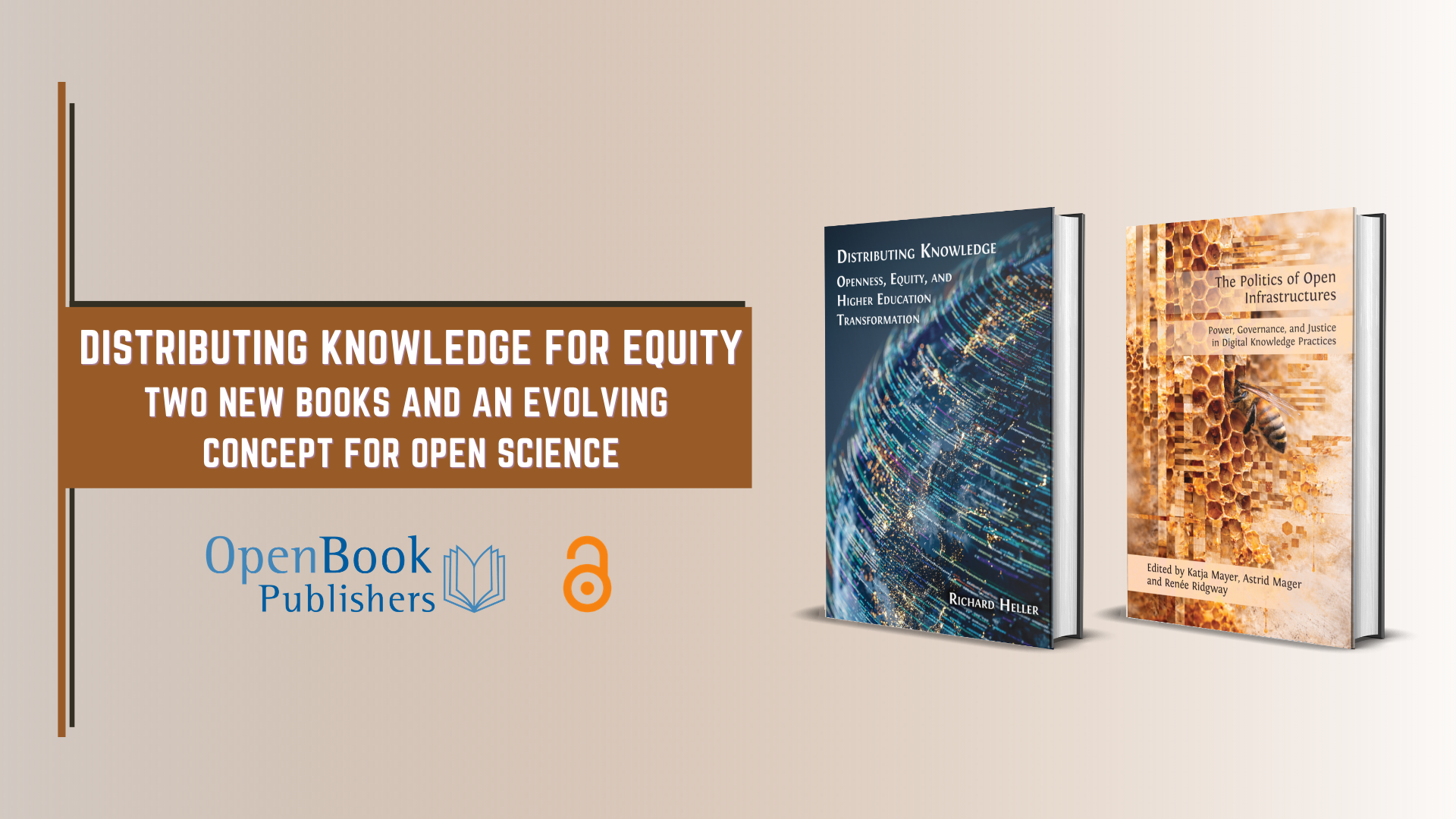
The publication of two open access books by the Diamond open access publisher Open Book Publishers stimulated a webinar to explore openness and equity in the distribution of knowledge.

Today there are more open journals, repositories, educational resources, and digital platforms than ever before. Yet this does not mean that knowledge has become equally accessible to everyone. An open resource can remain invisible; global infrastructure can reproduce inequality; and formally accessible data can create risks for individuals and communities. Openness on its own is therefore not enough. We also need to look at how resources, capacity, visibility, authority, responsibility, and benefits are distributed. This largely determines whether openness actually contributes to equity.
The publication of two open access books by the Diamond open access publisher Open Book Publishers stimulated a webinar to explore openness and equity in the distribution of knowledge. The session included presentations from Australia, Germany, Mexico, Nigeria, UK, and Ukraine. The recording is available to view online, and the slides are available to download.
Topics included how a distributed approach built on openness can contribute to equity in access to education and the production and publication of knowledge, how a distributed open infrastructure can support collaboration and new models of education in different global settings. The crisis response to the Russian invasion led to Ukraine’s ‘University without walls’ and a number of open education innovations, and demonstrated the potential for a wider application of a distributed model of education.
Openness is not enough
One of the most interesting outcomes of this conversation was that very different geographical and disciplinary contexts repeatedly brought us back to the same problem: openness is not enough.
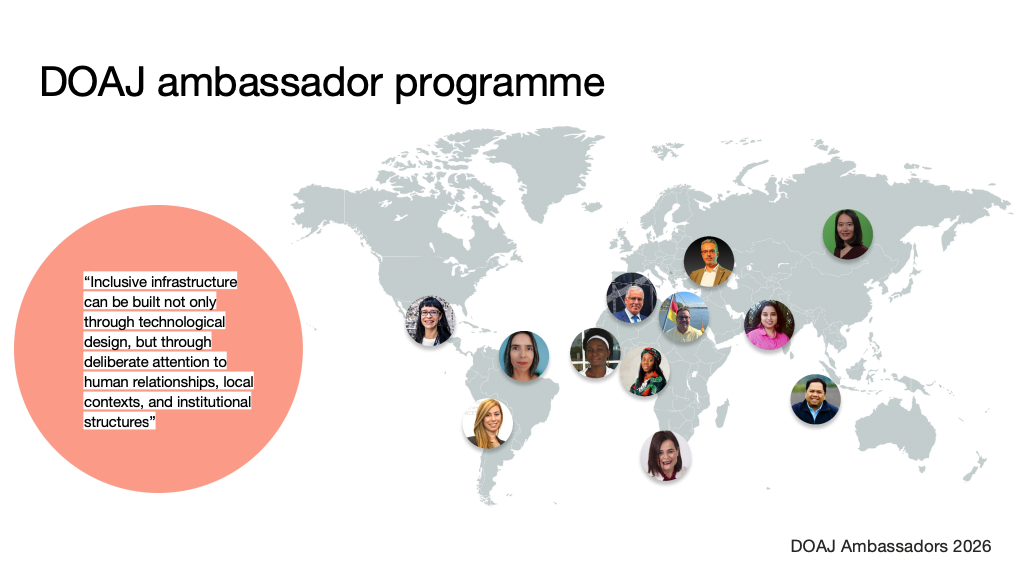
In open publishing, the experience of DOAJ illustrated this particularly well - inclusive infrastructure cannot be built through standards and technological solutions alone. Any classification system includes some and excludes others, while criteria developed in one context do not always work fairly in another. This is why DOAJ has developed its Ambassador Programme, involving people who work within local academic communities, understand local languages and practices, and are able to question the assumed universality of particular criteria. In this sense, inclusivity is not an end state but an ongoing process of negotiation, adaptation, and participation.
Building collaborative relationships while retaining local autonomy
A different tension emerges in open education — an open resource is not necessarily an accessible resource. Materials may be openly licensed and free to use, yet remain effectively invisible if they are hosted in isolated repositories, use incompatible metadata, or are not indexed by the services that teachers and students actually use. The question therefore shifts from “Where should we store all open knowledge?” to “How can different knowledge environments interact with one another without creating yet another dominant global platform?”
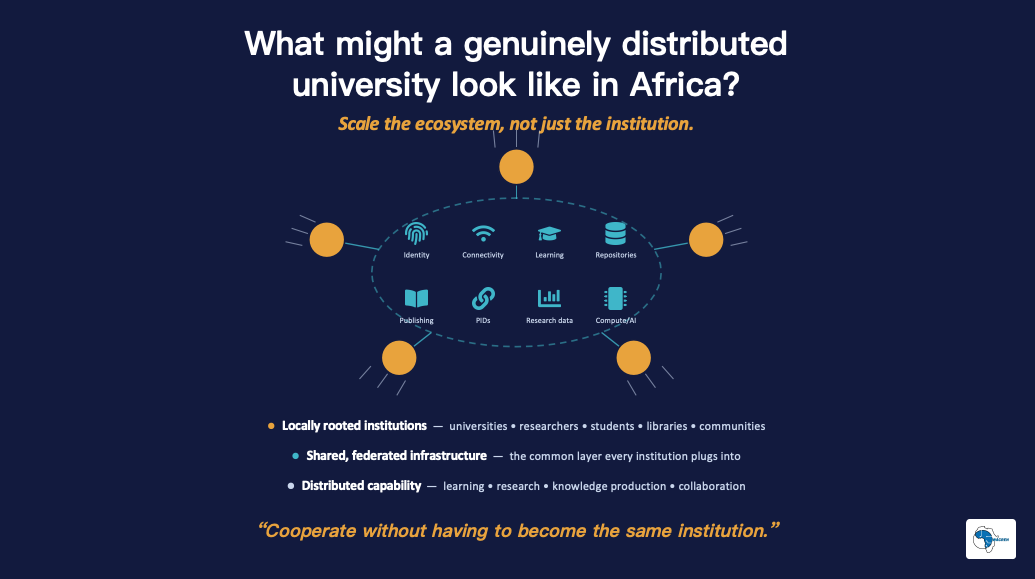
The same logic emerged from an African perspective where scaling the ecosystem, rather than the individual institution, is required. Universities do not necessarily need to reproduce an entire digital infrastructure independently if locally rooted and autonomous institutions can be connected through shared networks, repositories, digital identity, persistent identifiers, computing capacity, and other services. A formulation — “cooperate without having to become the same institution” — captures one of the central principles of a distributed model: collaboration should not require the loss of local autonomy.
What does it take to maintain connections in a distributed environment?
The Ukrainian experience adds another dimension to this discussion. War has confronted displaced universities with a very literal question: what makes a university a university when it loses its campus, laboratories, and shared physical space?
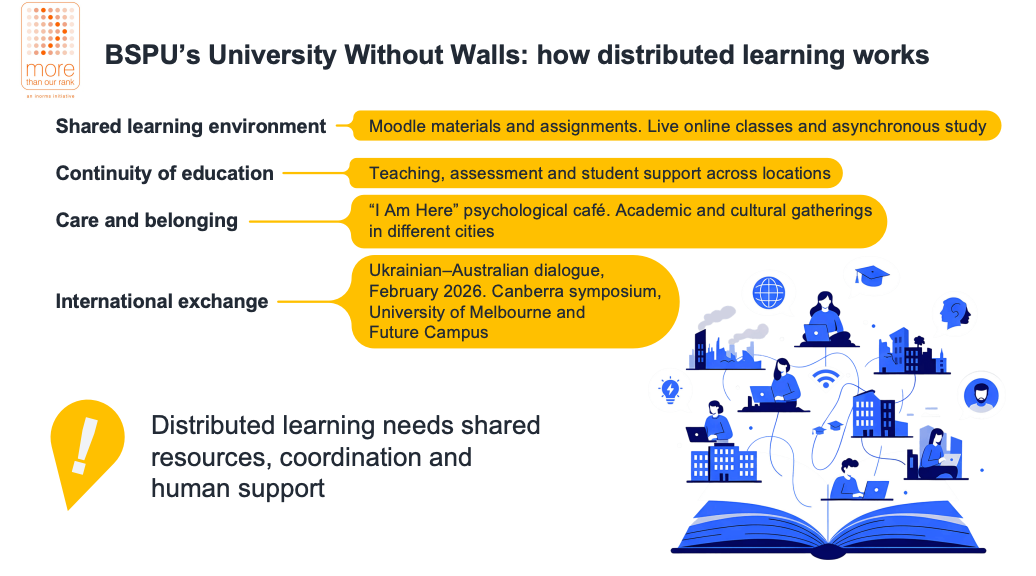
The experience of Berdyansk State Pedagogical University illustrates this. Following the occupation of Berdyansk, staff and students found themselves dispersed across different cities in Ukraine and abroad, yet the university continued to function as a shared organisation. The “University Without Walls” brought together Moodle, synchronous and asynchronous learning, assessment and student support, psychological assistance, academic and cultural meetings in different cities, and international exchange. This experience shows that distributed learning is not simply about digital technologies. It requires shared resources, coordination, institutional responsibility, and human support.
Who decides?
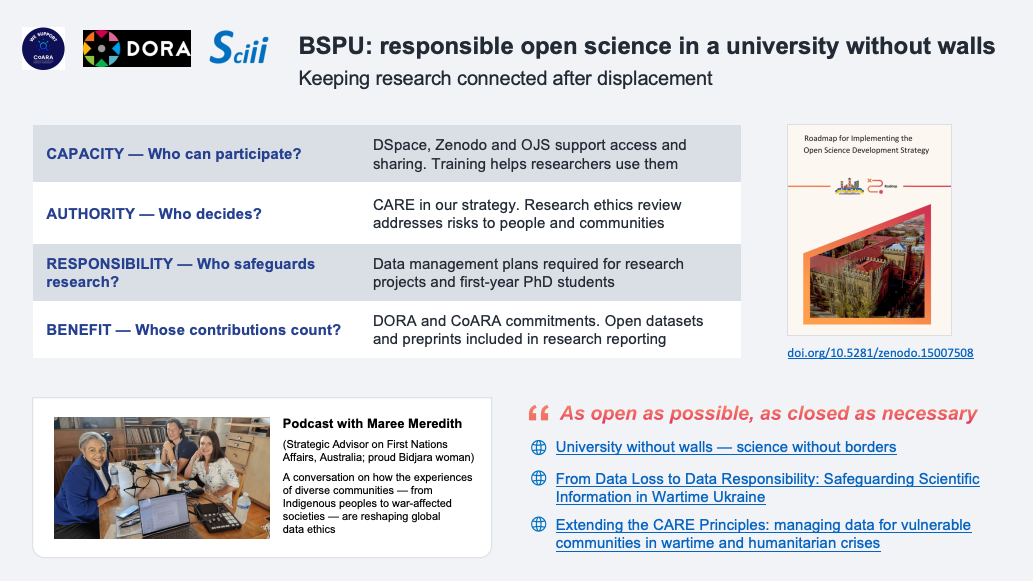
For open science, the issue becomes even more complex. Distributing knowledge means not only expanding access, but also distributing responsibility. In wartime, maximum openness is not always ethically appropriate. Data about researchers, students, or communities can create real risks. This is why the principle “as open as possible” must be balanced by “as closed as necessary.” In Berdyansk State Pedagogical University’s experience, this means combining open infrastructure with the CARE Principles, ethics review, data management plans, and a broader understanding of research responsibility.
From this emerge four questions that may be useful far beyond the Ukrainian case: Who has the capacity to participate? Who makes decisions? Who takes responsibility? Who benefits? These questions help move us from understanding openness simply as access towards understanding distribution as a set of relationships among people, institutions, and infrastructures.
Distributed knowledge, power and governance
This is where the different contributions begin to form a coherent picture. DOAJ raises the question of the distribution of the power to define criteria. Distributed Learning Ecosystems raise the issue of visibility and the ability to find knowledge. The African model concerns the distribution of infrastructural capacity without loss of autonomy. The “University Without Walls” concerns the distribution of education, support, and institutional presence across different locations. Open science in wartime brings in the distribution of responsibility and protection.
In this sense, the concept of distributed knowledge developed in the book Distributing Knowledge: Openness, Equity, and Higher Education Transformation is useful because it encourages us to move from asking whether knowledge is open to asking a more complex question: how are relationships around knowledge organised? His concept of the Distributed University invites us to see higher education not as a collection of autonomous campuses, but as a network of interconnected educational, research, and infrastructural capacities in which equity and openness become foundational principles.
At the same time, the second book, The Politics of Open Infrastructures: Power, Governance, and Justice in Digital Knowledge Practices, adds another important dimension to the discussion. Openness and distribution are not neutral technical characteristics. Infrastructures have their own rules, governance models, and centres of decision-making. Questions of access therefore sit alongside questions of power, participation, and justice: who defines standards, whose practices become visible, who can influence the rules, and who remains outside them.
Taken together, these two perspectives allow us to think about openness more broadly: not only as access to knowledge, but as a system of relationships in which resources, visibility, authority, responsibility, and benefits are distributed.

Making it work in practice
This also points to the next step. What is needed is not another declaration in support of openness, but a closer examination of how the distribution of knowledge works in real systems. Can universities share infrastructure while preserving autonomy? Can global systems remain locally governed? Can openness broaden participation without increasing risk? And can models developed under crisis conditions, such as the “University Without Walls,” help us rethink higher education far beyond the context of crisis?
Taken together, these two perspectives allow us to view openness more broadly — as a system of relationships in which what matters is not only access to knowledge, but also the distribution of resources, visibility, authority, responsibility, and benefits.
The next step is to examine how these principles work in real institutional environments. We are interested in how universities can share infrastructure while retaining autonomy; how global systems can take local governance and context into account; and how participation can be broadened while risks are handled responsibly. It is also worth exploring what models developed under crisis conditions, including the “University Without Walls,” may contribute to a broader rethinking of the future of higher education.
A call to action
The discussion brought together complementary perspectives on open publishing, education, infrastructure, and open science around the questions of equity, participation, autonomy, and distributed systems. Participants agreed on the need to explore these issues in a systematic way in the face of the crisis facing the higher education sector globally.
We plan to come together virtually to explore these issues in depth to offer solutions and suggestions for the transformation of higher education. We call for those interested to join us in this exploration.
On behalf of the webinar presenters:
Lucy Barnes, Senior Editor and Outreach Coordinator, Open Book Publishers; Richard Heller, Emeritus Professor, Universities of Manchester UK, and Newcastle Australia; Ivonne Lujano, Post-doctoral researcher, El Colegio Mexiquense, Mexico, and Community Manager and Ambassador at the DOAJ; Igor Lyman, Head of Department of History and Philosophy, Berdyansk State Pedagogical University, Ukraine: Omo Oaiya, Chief Strategy Officer, West and Central African Research and Education Network (WACREN); Daniel Otto, Professor of Educational Technology and Digital Education, European University for Innovation and Perspective; Yana Suchikova, Vice-Rector Research, Berdyansk State Pedagogical University, Ukraine