
Spelling, Prescriptivism, and Benjamin Franklin
Franklin's spelling system reveals a lot about what he believed to be correct and proper English: not his own Boston accent, and nothing American, but the contemporary London way of speaking.

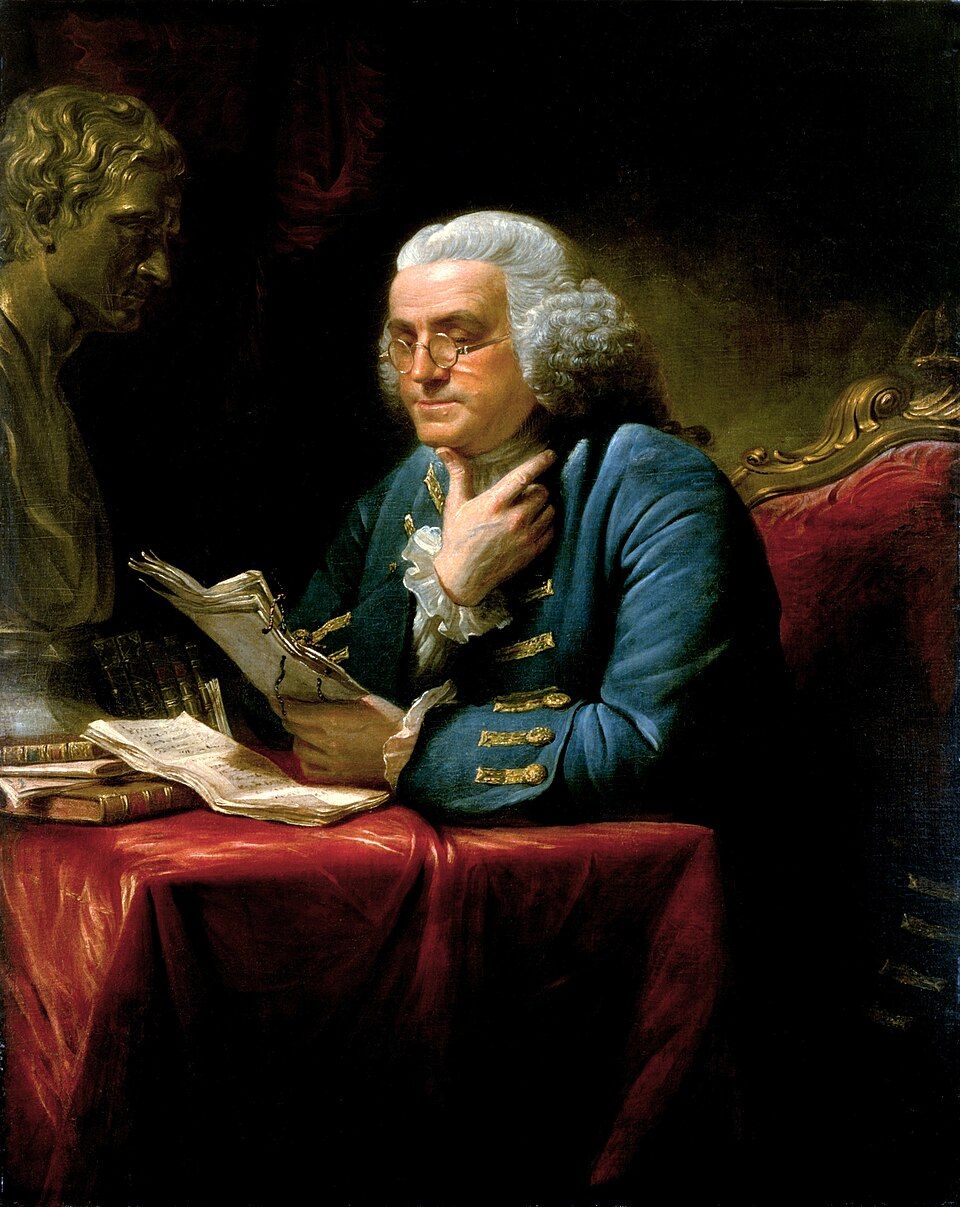
By Alice Battersby
In a recent debate in Parliament, MPs spoke about the pressure on people to change their accents to advance in their careers. People are keenly aware that others judge them according to their accent, and that employers may view regional accents as a sign of unintelligence or unprofessionalism. As MP Ian Lavery pointed out, accent discrimination is far more acceptable in society than discrimination on the basis of other characteristics. When this extends to categorising certain accents as incorrect and enforcing use of the standard, it is known by linguists as prescriptivism.
This is not new. People have a strong tendency to ascribe social meaning to accents, and to judge people according to how they speak. Those whose own accents are judged incorrect can be ashamed of them. One example of this comes from a perhaps unlikely source – a spelling system devised by Benjamin Franklin in the 1700s (along with his related writings), and discussed by Gary German in his recent two-volume open access study, Benjamin Franklin, Orthoepist and Phonetician.
First drafted in 1768, then published in 1779 in an anthology (Political, Miscellaneous and Philosophical Pieces Written by Benjamin Franklin), Franklin's spelling system reveals a lot about what he believed to be correct and proper English: not his own Boston accent, but the contemporary London way of speaking.
The spelling system had several purposes. Franklin believed it would make English easier to spell, by ensuring each letter corresponded to one sound, and that the sound was always the same. Franklin particularly envisioned it allowing children to learn to read and write more quickly. However, according to Gary German’s research, Franklin did not base this system on his own Boston accent, but instead on a London accent of the time. The spelling system was therefore intended to function as a method of presenting the ‘correct’ accent of English to speakers of other accents.
Evidence for the spelling system reflecting London pronunciation comes from several sources. German argues that Franklin’s letter to Polly Stevenson, his confidante and a Londoner, shows that Franklin wished to use her London speech as a model for his system.
‘I wish you to consider this Alphabet, and give me Instances of such English words and Sounds as you may think cannot perfectly be expressed by it. I am persuaded it may be completed by your help.’
This suggests that in his mind, her way of speaking was the proper way of speaking English, and the one he wished to promote. Furthermore, Franklin lived nearly fifteen years in London and spoke with some of the most powerful and illustrious Englishmen of his time.
Franklin’s transcriptions using his spelling system also indicate his attempts to bring the system closer to London speech. One example of this is the spelling of the sound written <y> in words such as ‘perfectly’ or ‘hurry’. Franklin’s original transcriptions of this word in his 1768 letters to Polly Stevenson indicate a pronunciation as a diphthong, a sound formed by the blending two vowels, in this case ‘uh’ + ‘ee’. The vowel here seems to have been pronounced similarly to the word ‘lie’. In a later letter to Polly, he adapts his transcription of perfectly to the more evolved ‘ee’ monophthong now used in contemporary Received Pronunciation and General American English. German suggests that the initial transcription is an error reflecting Franklin’s Boston English, which he later corrected to reflect the pronunciation in London, perhaps on Polly Stevenson’s advice. Further evidence for this comes from his poems, the earliest of which was published in 1719 when he was only thirteen and in which he rhymed ‘die’ and ‘manfully’, suggesting the final sounds were the same for him. This shows that Franklin wanted to replicate what he viewed as the standard. Regional variations such as his own were not to be included in his spelling system. The London pronunciations, to him, were the ones worthy of being taught.
Considering the context of the time, this could be viewed as surprising. When Franklin initially drafted his spelling system, the relationship between Parliament and colonial American legislatures was worsening, and the book of Franklin’s writings was published during the War of Independence. Why would Franklin, in this political context, have based his system on London speech? Not everybody made the same choice. The lexicographer Webster, writing a few years later, argued against the idea of using the language of contemporary Great Britain as a model. German points out that Webster criticised London English as having deviated from older ‘purer’ English spoken in England during its Golden Age, that is, prior to 1727. Webster firmly believed that the English spoken in New England preserved the older pronunciation of England and that this should be the model for America. On the contrary, he considered that London English was evolving too far away from this older English model. Volume 2 of German’s book presents hundreds of examples supporting this contention.
And Franklin also had a lot of affection for his native Boston accent. Shortly before his death, he wrote that ‘the Boston manner, turn of phrase, and even tone of voice, and accent in pronunciation’ were all pleasing to him, and were part of the reason why he wanted to visit his hometown again.
But though Franklin was hostile towards certain political aspects of Britain, such as the monarchy, this did not extend to its speech. Americans and Britons alike often forget that Franklin was a staunch Whig who enjoyed considerable support in England (e.g. former Prime Minister William Pitt). He was also a British patriot and defender of the British Empire who passionately believed that America’s role was crucial to its future greatness. Given that London was the capital of the Empire, Franklin believed that the English of educated Londoners should be the model for all English speakers. It was on this London model that he attempted to base his Reformed Mode of Spelling, not entirely successfully. Additionally, despite liking his native speech, Franklin seemingly believed it was simply inferior to that used in London. In his Autobiography, Franklin states he was ‘a bad speaker’ and ‘hardly correct in language’, and in earlier letters, he states he will ‘give up as bad’ words that were not in common use among Londoners.
Why would Franklin have thought this? German cites Looby, who suggests that Franklin would have become keenly aware of the social value of his accent when arriving in London to work as a printer’s apprentice at the age of 19. The differences between his own speech and the speech of those around him would have been obvious. Significantly, the speech he heard would have been the speech of the powerful and educated elite. As people do today, Franklin would have viewed the speech of these people as ‘correct’, making his own provincial and ‘incorrect’.
In this way, Franklin faced the same struggle in the 1700s as so many face today, including the MPs taking part in the recent debate. He spoke in a way that he believed to be inferior, but that he still liked and perhaps viewed as part of his identity. And as is the case today, the way of speaking that he believed was correct was largely arbitrary. Prescriptivism has existed for a long time. Perhaps it’s time to let it go.
Gary German's two-volume study is freely available in PDF and HTML, and available at a reasonable price in paperback, hardback and EPUB:
- Benjamin Franklin, Orthoepist and Phonetician, Vol. 1: Language, Literacy and Social Mobility in Franklin’s World
- Benjamin Franklin, Orthoepist and Phonetician, Vol. 2: Colonial American Voices and London Norms: Franklin’s Quest for an Orthographic Reform