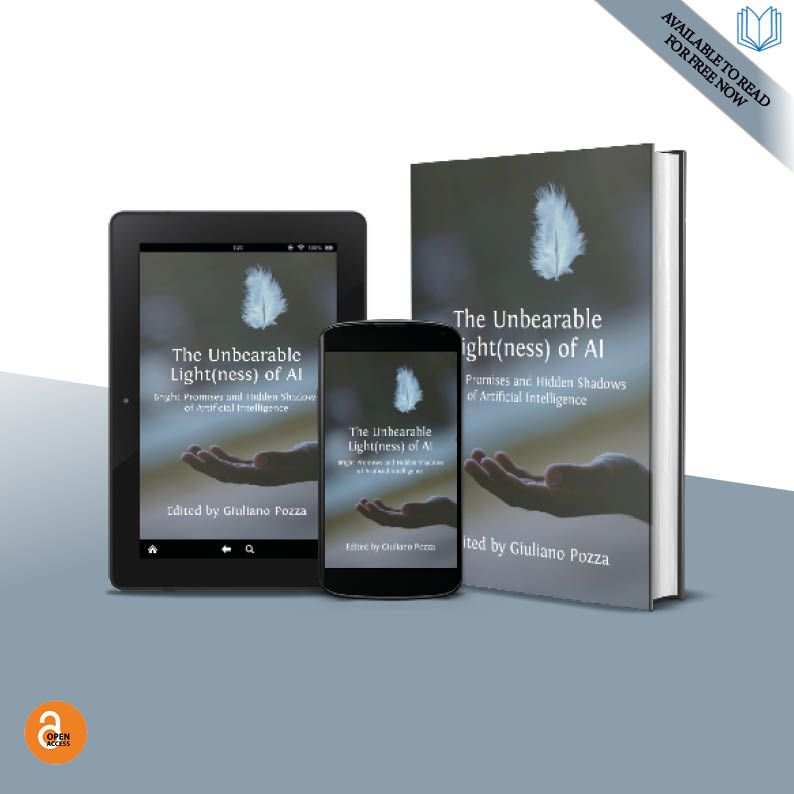
The Unbearable Light(ness) of AI
The central theme running throughout the book is the tension between the challenges posed by AI and the opportunities it presents when developed and governed responsibly.


By Giuliano Pozza
"What should we choose, heaviness or lightness?"
Our collection of essays, The Unbearable Light(ness) of AI, starts from this question, contained in the unforgettable The Unbearable Lightness of Being (1984) by Milan Kundera, to try to reason about Artificial Intelligence (AI) in an unconventional way. Some might wonder if there is a need for another book on AI, but we believe that this contribution can offer something original to the discussion of a vast and complex topic.
Through the lens of Kundera’s question, the book explores themes of sustainability, inclusion, ethics, digital sovereignty, education and learning, work and organizational impacts, security and medicine of the future. For each of these areas, both lightness and heaviness are analysed, showing that, as Kundera said, in heaviness there is sometimes a depth that allows us to better appreciate lightness as well.
The authors position themselves, taking a cue from Plato, as "sceptical believers" and they searched for positive deviants in each of these areas. The book invites us on an adventurous journey and, as J.R.R. Tolkien reminds us, in every adventure there are sometimes uncomfortable situations.
The central theme running throughout the book is the tension between the challenges posed by AI and the opportunities it presents when developed and governed responsibly. Each chapter explores this duality by pairing a significant societal challenge, such as environmental sustainability, exclusion, inequality, loss of digital sovereignty, or barriers in healthcare and higher education, with a corresponding promise of AI, including more sustainable innovation, greater inclusion, improved health outcomes, stronger institutional autonomy, and the transformation of education. Rather than presenting AI as inherently beneficial or harmful, the authors examine the conditions under which it can become a force for positive change. Across diverse topics, the chapters demonstrate that the impact of AI depends not only on technological advances, but also on human choices, governance frameworks, and societal values. Together, these essays offer a balanced perspective on how AI can help address some of society's most pressing challenges, provided it is designed, deployed, and regulated in ways that prioritise fairness, transparency, sustainability, and the public good.
The Unbearable Light(ness) of AI is freely available in PDF and HTML; it can also be purchased in paperback, hardback and EPUB formats.